Wednesday, April 25, 2012

Contemporary Artist: Jerome Witkin
"Jeff Davies" (top left)
      Jerome Witkin likes to paint realistic figures in realistic but grungy looking settings.  He is also known for a lot of work relating to or about the Holocaust.  This piece is a simple portrait of a common working man who seems to be quite overweight with the addition of a thick coat.  The fabric is painted very well and out of focus areas are left to show a sense of depth in an interesting way.


"Are You Here?" (right)
      The story behind this painting is that Witkin was trying to find the proper pose for his most beautifl model but had failed to do so until she broke pose and casually turned her gaze away when he quickly captured the moment.  I love the scatter of arbitrary objects that gives the studio space the feel of most every studio space I have worked in.  The high level of detail and still life starts to flatten the image as a whole, though.


"The German Girl" (bottom left)
      This nightmarish painting is one of Witkin's Holocaust themed works that suggests the ghosts of the past have returned to haunt the young girl.  This may suggest that there are deeds to be answered for or horrible things gone forgotten that need to be remembered.


Contemporary Artist: Vincent Desiderio

"Boating Party" (top left)
   I have decided that Desiderio paints figures in realistic space as if those people were objects in a still life.  There is often a sense of exasperation or a lack of liveliness to the people he chooses to paint.  I love the sense of depth in this piece with the many layers of figures and objects.  The colors seem to be from a realistic palette instead of muted with contrast or shadows.  Even though there are two human bodies, there is no suggestion of life from either of them.

"Interpretation of Color" (right)
     Again in this paiting there are varied levels to provide the illusion of depth in the painting.  deeper areas are granted richer colors to show depth.  The man is fainted or dead on the floor.  There is no sign of life in the man in this painting which arouses many questions and even further questions by the array of artist books scattered across the floor.  There does seem to be an atmospheric quality to this piece as you get farther away from the center, a turquoise blue cloudiness. 

"Sink" (bottom left)
     This woman was apparently drowned in a sink the transluscency of her attire is curious but impressive.  Besides the more healthy looking tones of her arms, legs, and torso, her head seems to be a lighter shade of blue which suggests suffocation or that maybe her head is still underwater.


Contemporary Artist: Jacob Collins
"Candace Profile" (top right)
      Jacob Collins specializes in creating hyper-realistic nude figures.  I chose this artist because I am still working on becoming better at rendering faces and it is easy to see the contours of the faces of these people unobstructed in profile or portrait.  It is interesting to see how he captured the change in tone across her torso and face.  This is obviously an expert rendering of te female figure.

"Thinking Man" (left)
      Another great example of figural rendering.  There are great highlights across his head and his arm and legs.  there seems to be some rotation in the figure's back that doesnt make sense to me from the position of the man's legs and the shading in the curved muscles of his back seem slightly flat but still a very impressive piece.  His head bends down in contemplation looking towards his knees with most of his weight leaning back on his arms. The front of his body is lit in contrast to the flat colors of the background.

"Santiago Sheila" (bottom right)
      A nude male and female figure lay on a flat sheeted surface presumably a bed.  The man is clearly the focus of the frame and is in a position of contemplation.

Contemporary Artist: Lucien Freud

"Leigh on a Green Sofa" (top right)
     This work is more like what we have done in studio looking at just nude models posing for extended periods of time.  It is a very quick interpretation of light and shadow over the figure and a snapshot of the musculature and skin positions of the stretched out moment in time.  I like the washed out green undertone of this image that gives the figure a sense of having been drowned instead of resting.

"Benefits Supervisor Sleeping" (left)
     This paiting is the most expensive painting ever sold while the creating artist was still alive back in the 1990's.  In our studio, we had to draw a figure as if he was extremely engorged with fat and interpret how gravity would react to his body.  The sags and folds of this woman's skin is heavily flowing downward over her sofa and her own body.

"Girl with Closed Eyes" (bottom right)
     This paiting looks like a schematic look at the highly saturated areas of the figural torso and face.  It takes into account both where the shadows and highlights are but also where there is more vibrant fleshy hues. 
Modern Artist: John Singer Sargent

"Wertheimer Sisters" (top left)
     I chose this piece for the dresses the women are wearing to adequately portray the curves of their figures amongst the aray of folds in the shadows and highlights.  Even with very deep color tones and assumed vibrant gilded frames of paintings behind thefigures, the contrast of this piece seems to mute the colors present.  It is not that interesting of a piece with posing figures facing the viewer but very professionally executed.

"El Jaleo" (right)
     This paiting has a much more interesting composition and atmospheric quality.  There is an extreme measure of abstract movement by the dancing figure and her flurry of fabric.  I really like Sargent's dark tone quality and high contrasting figures with very pale skin.

"Madame Gautreau" (bottom left)
     I like the brush strokes that are evident in this painting, The hyper realistic face stands out against the background in both color and painted texture.  Her line of sight appears to be parallel to her extended arm.

Modern Artist: Winslow Homer

"Snap the Whip" (top right)
     Unlike most of the other artists I have chosen, Winslow Homer uses many bright vibrant color schemes but from a more earthy palette.  Most of his work is incorperated into a vast detailed landscape with figures in the foreground as the subject matter.  This painting shows a group of children I learned to be called "crack the whip."

"Waiting an Answer" (left)
     This painting shows an emotional tension between a young man and a young woman.  The man is looking towards the woman while she looks arbitrarily into space in concentration or pondering.  The way the broken light is shown through the tree is reflecting off of both figures in interesting ways.  There is a balance in the duality of the way both figures are positioned on the canvas.

"Watching the Breakers" (bottom right)
     This is my favite piece that I chose by Winslow Homer.  I really enjoy the undersaturated tones of color that illustrate what would potentially be a very powerful natural experience.  I like the uniqueness of the surrounding landscape he chose for this piece.


Modern Artist: Gustave Courbet

"Self-Portrait" (top left)
     The self-portrait of Courbet really captured my attention with his expression.  In his thrown up arms, you can appreciate the attention to detail in the extrusion of tendons and veins that express tension or movement.  The color scheme of the painting is very minimally greyscale with some subtle hues of yellow and green in the background and in his skin, but there is a bright blush of red in his cheeks that suggests embarassment.

"Sleep" (right)
     In an erotic display of lesbian intimacy, Courbet captures a moment of passion between two lovers.  The folds of the fabric are expertly shaded and I was impressed by the rendered glass objects in the foreground.  The dark blue background really contrasts with the pastey white skin of the women.  I just chose this piece because I had never expected to find a painting of two lesbians from this time period.

"Johanna Hiffernan" (bottom left)
     This portrait is another example of Courbet's expertise in showing emotion on human facial expressions.  Although her fingers seem to be in an uncomfortable and unrealistic position and her jawline seems to be overextended, her long rippling hair shows real deptch and shading.


Modern Artist: Mary Cassatt

"Young Mother Sewing" (top right)
     The contrast of this piece, or of this artist rather, is what caught my attention.  The light white and pastel colors make the dark areas of hair and eyes stand out.  This painting is very balanced vertically on a central axis where the faces of the mother and child fall into place.  There is a sense of placidity in the mother's face while there is a feeling of anxiousness in the young girls expression.

"Mother" (left)
     In this painting, a baby or toddler girl explores the contours of her mother's face.  The child looks very healthy and playful while the mother comes across as somewhat stoic or stern.  The fabric of their clothes is perfectly rendered.  Although there is a lack of pigment over the rest of their bodies, both the mother and daughter have a similar touch of blush that ties them together.  Their gaze catches each other and one can appreciate the simplicity and timelessness of the relationship between mother and daughter.

"Toreador" (bottom right)
     Unlike her other work, Mary Cassatt created this figure in a really dark setting.  Most of her work is very light with pastel colors with slight touches of vibrent accents with very clear atmostpheric qualities.  Maybe the lack of background in this piece is what gives it a smog-like atmosphere instead of grounding the man in a three-dimentional space.

Friday, February 17, 2012

Spanish Renaissance: El Greco

"The Purification of the Temple" (1570, top left)
     The many people in this painting are rendered somewhat loosely with bright colored clothes but dull colored flesh.  I find it interesting that some of the faces seem so calm while others are conveying extreme emotion and panic.  The head of Jesus is almost directly in the center of this painting, but I found it very curious that the perspective lines of the floor tiles lead somewhere far to the left of the center completely away from Jesus which is very atypical.  While Jesus does not show anger, the intense colors of his clothes seem fiery and vengeful.

Fray Hortensio Felix Paravicino by El Greco"Fray Hortensio Felix Paravicino" (1609, right)
     I really admire the loose brush strokes that El Greco uses around the clothes and less interesting parts of his figures.  The lopsidedness of this painting also makes it more interesting to look at as far as giving the background context against the frame and layout of the canvas.  The contrast in this painting makes the calm disposition of the man featured seem much more intense.  Again, it seems that this man is much more pale than one would think of a living human being.

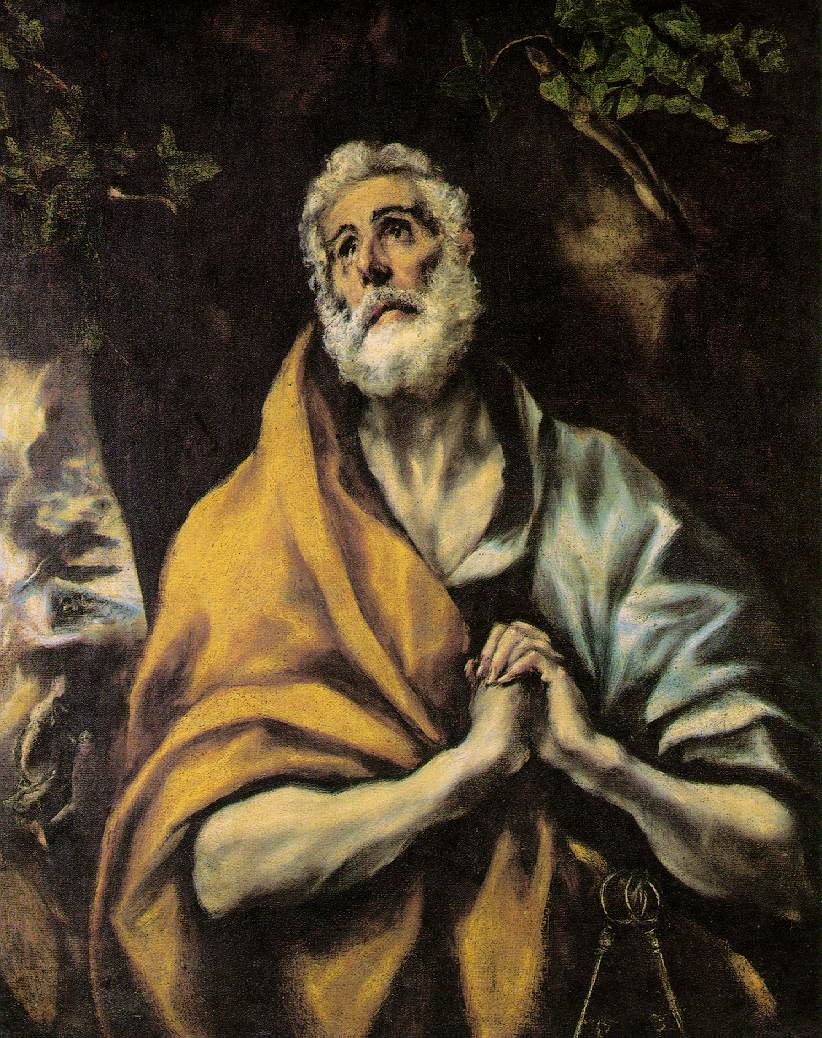
"The Repentant Peter" (1600, bottom left)
     The image of Peter in Renaissance paintings is often paired with a set of keys as the keeper of the gates of heaven.  The elongated neck and face of this apostle gives him a very sad and mournful emotion as if for his betrayal of Jesus on the day of his crucifixion.  The background is rather plain and washed out with very dark colors to make Peter stand out more as a very light-pale figure to create the illusion of holiness.  Again, it seems that Jesus and his followers are depicted as white European in this painting and "The Purification of the Temple"

Wednesday, February 8, 2012

German Renaissance: Albrecht Durer

"Adam and Eve" (1504, top right)
     This engraving shows the moment that Eve gives the apple, given to her by the deceiver, to Adam; also known as the fall of mankind.  The animals surrounding their feet represent the theory of the four temperaments.  Durer leaves his signiture on his work by means of the sign held by Adam.  The illusion of three-dimentionality exists in this piece in the forshortening of the forearms of both Adam and Eve on theviewer's left side each.  Eve has very masculine shoulder muscles that seem to overtake her neck but the two figures are very well rendered in a classical style common to the Renaissance era.

"The Four Witches" (1497, left)
     This engraving is of four nude women who are not greatly identified as characters of religious legend or stories.  They gather in front of an open portal and stare at a hanging sphere that resides centrally in the close quarters they inhabit.  To the left side of the engraving, a demon yells from the flames that consume it. The women are rendered fairly accurately but with, maybe, an excessively large posterior protruding from the backside of the woman to the left; but the shading in the muscles of their backs and the tendons at the fold of their legs is quite impressive.

"The Battle of the Sea Gods" (1475, bottom right)
      This engraving shows several male and female figures with a nude costume.  The detail and shading on their bodies is less detailed here than in some of the other engravings by Durer; but the lack of shadings allows the viewer to acknowledge the muscular framework in its most basic of the figures.  Two god-like beings with the torso of men, the tail of a leviathan, and the front legs of a horse quarrel violently in the swirling waves.

Wednesday, February 1, 2012

Italian Renaissance: Raphael Sanzio

"The Three Graces" (1504, top left)
     The women in this painting share many attributes such as the angle of their bent arms, their balanced stance with the weight of their body centered over one leg while the other is at rest, the tilt of their heads, and their extremely similar physique. The spheres that they hold in their hands are likely to be fruit which is often representational of sexual temptations of the female form. Strangely, they all seem to be facing towards the object they are holding as if mesmerized by it, mesmerized by their sexuality maybe, or flaunting it for the viewer.

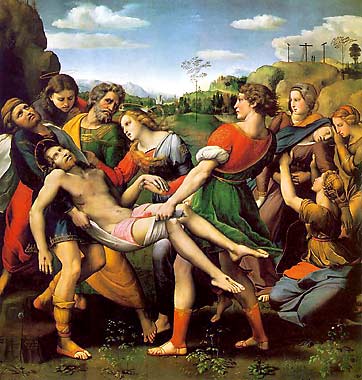
The Entombment
"The Entombment" (1507, right)
     This painting is of white European Jesus after His crucifixion and the white Renaissance European people who came to first century Palestine to relocate his body to his designated tomb. It is interesting to see the weight of the body of Jesus passed through the two men who appear to be carrying him, according to the angle and flex of their bodies. The hand of Jesus is held by Mary Magdaline.  In balance with the limp body of Christ, His mother, Mary, falls limp on the right side of the painting into the arms of several women tending to her. 

"The Blessing of Christ" (1506, bottom left)
     In this portrait of white European Jesus, the figure raises His right hand with middle and pointer fingers extended to offer a blessing as was, and is still, customary in the Catholic religion.  His other hand reaches acrost His chest towards one of the wounds during the crucifixion from a spear in His side.  The pectoral and upper abdominal muscles depict a toned male body while the broad hips, less toned lower abdomen, and delicate facial structure suggest a more feminine figure.

Wednesday, January 25, 2012

Italian Renaissance: Paolo Veronese

"Allegory of Wisdom and Strength" (ca. 1580; top right)
     The female figure of divine wisdom is joined with Hercules, a figure representational of brute force and strength.  I chose this Veronese painting because I was impressed with the body alignment of the woman.  You can follow the weight of her body down the curvature of her spine to her center of weight, around her pelvic region, which is directly centered over her left foot which is supporting her weight.  Wisdom in this imagery is very balanced and modest.  However, the being of strength is shoved off balance and depicted as very obvious and censored with lesser quality garments.  The heads of both figures form and equilateral triangle with the point where their bodies connect at the hip.

"Temptation of St. Anthony" (1552-1553; left)
     I chose this image for the depiction of the man in the center with his arm raised.  I was intrigued by the texture of his back muscles and arm muscles when they are all contracted.  It shows the potentiality of force and the movement of his entire frame towards the older man, Saint Anthony, on the ground in front of him.  I will have to consider the fact that the muscles of the body are comprised of parts that all retract or expand to achieve movement and all can been seen and rendered as individual elements.  The extreme detail on the wrist of Saint Anthony is also very impressive, with the various tendons in tension, and muscles bulging, and even veins pulsing from his aged arm.

 "Allegory of Love: Unfaithfulness" (ca. 1575; bottom right)
     This scene depicts a woan caught cheating with another man and the emotional conflict of betrayal and lust.  The woman figure in this painting is the most interesting for the topic of figurative imagery.  You can folow the axes of her body through the turn of her waistline and the angle of her shoulders and how those two points direct the position of the rest of her body.  The children are a bit out of scale having smaller heads then is typical and looking like shrunken adults in their body proportions, but this is common in Italian Renaissance work.

Tuesday, January 24, 2012

ru·mi·na·tion - n. 1) A calm, lengthy, intent consideration  2) The act of pondering; meditation.
By precedent, I am referring to the work of past artists who, through experiment and discovery, created a basis, a foundation, from which we have come to understand art and the nature of the visual world around us. 

The precedent which I hope to examine is the nature of the anatomical and figurative towards achieving a higher standard in my own work with guidance and patience.