Friday, February 17, 2012

Spanish Renaissance: El Greco

"The Purification of the Temple" (1570, top left)
     The many people in this painting are rendered somewhat loosely with bright colored clothes but dull colored flesh.  I find it interesting that some of the faces seem so calm while others are conveying extreme emotion and panic.  The head of Jesus is almost directly in the center of this painting, but I found it very curious that the perspective lines of the floor tiles lead somewhere far to the left of the center completely away from Jesus which is very atypical.  While Jesus does not show anger, the intense colors of his clothes seem fiery and vengeful.

Fray Hortensio Felix Paravicino by El Greco"Fray Hortensio Felix Paravicino" (1609, right)
     I really admire the loose brush strokes that El Greco uses around the clothes and less interesting parts of his figures.  The lopsidedness of this painting also makes it more interesting to look at as far as giving the background context against the frame and layout of the canvas.  The contrast in this painting makes the calm disposition of the man featured seem much more intense.  Again, it seems that this man is much more pale than one would think of a living human being.
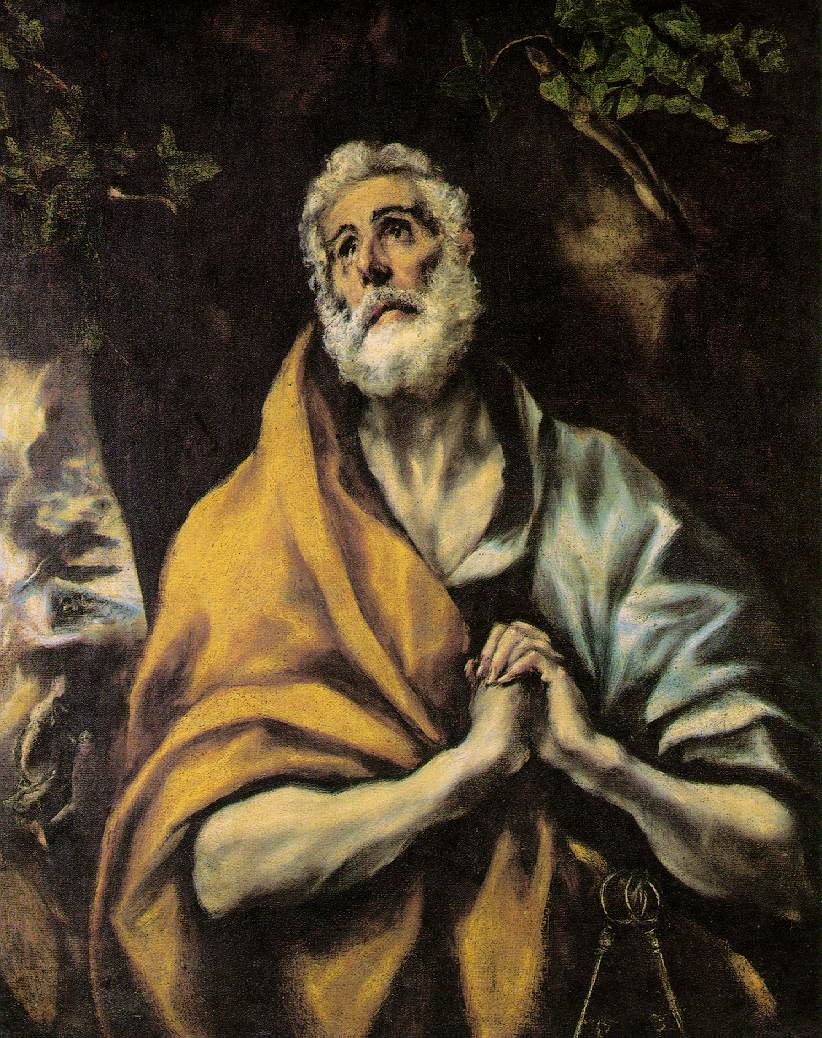
"The Repentant Peter" (1600, bottom left)
     The image of Peter in Renaissance paintings is often paired with a set of keys as the keeper of the gates of heaven.  The elongated neck and face of this apostle gives him a very sad and mournful emotion as if for his betrayal of Jesus on the day of his crucifixion.  The background is rather plain and washed out with very dark colors to make Peter stand out more as a very light-pale figure to create the illusion of holiness.  Again, it seems that Jesus and his followers are depicted as white European in this painting and "The Purification of the Temple"

Wednesday, February 8, 2012

German Renaissance: Albrecht Durer

"Adam and Eve" (1504, top right)
     This engraving shows the moment that Eve gives the apple, given to her by the deceiver, to Adam; also known as the fall of mankind.  The animals surrounding their feet represent the theory of the four temperaments.  Durer leaves his signiture on his work by means of the sign held by Adam.  The illusion of three-dimentionality exists in this piece in the forshortening of the forearms of both Adam and Eve on theviewer's left side each.  Eve has very masculine shoulder muscles that seem to overtake her neck but the two figures are very well rendered in a classical style common to the Renaissance era.

"The Four Witches" (1497, left)
     This engraving is of four nude women who are not greatly identified as characters of religious legend or stories.  They gather in front of an open portal and stare at a hanging sphere that resides centrally in the close quarters they inhabit.  To the left side of the engraving, a demon yells from the flames that consume it. The women are rendered fairly accurately but with, maybe, an excessively large posterior protruding from the backside of the woman to the left; but the shading in the muscles of their backs and the tendons at the fold of their legs is quite impressive.

"The Battle of the Sea Gods" (1475, bottom right)
      This engraving shows several male and female figures with a nude costume.  The detail and shading on their bodies is less detailed here than in some of the other engravings by Durer; but the lack of shadings allows the viewer to acknowledge the muscular framework in its most basic of the figures.  Two god-like beings with the torso of men, the tail of a leviathan, and the front legs of a horse quarrel violently in the swirling waves.

Wednesday, February 1, 2012

Italian Renaissance: Raphael Sanzio

"The Three Graces" (1504, top left)
     The women in this painting share many attributes such as the angle of their bent arms, their balanced stance with the weight of their body centered over one leg while the other is at rest, the tilt of their heads, and their extremely similar physique. The spheres that they hold in their hands are likely to be fruit which is often representational of sexual temptations of the female form. Strangely, they all seem to be facing towards the object they are holding as if mesmerized by it, mesmerized by their sexuality maybe, or flaunting it for the viewer.

The Entombment
"The Entombment" (1507, right)
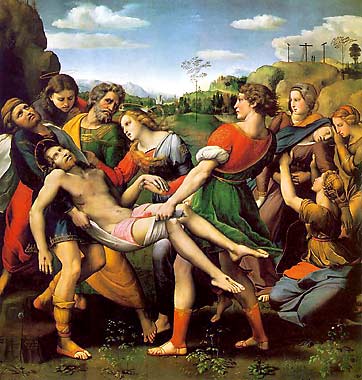
     This painting is of white European Jesus after His crucifixion and the white Renaissance European people who came to first century Palestine to relocate his body to his designated tomb. It is interesting to see the weight of the body of Jesus passed through the two men who appear to be carrying him, according to the angle and flex of their bodies. The hand of Jesus is held by Mary Magdaline.  In balance with the limp body of Christ, His mother, Mary, falls limp on the right side of the painting into the arms of several women tending to her. 

"The Blessing of Christ" (1506, bottom left)
     In this portrait of white European Jesus, the figure raises His right hand with middle and pointer fingers extended to offer a blessing as was, and is still, customary in the Catholic religion.  His other hand reaches acrost His chest towards one of the wounds during the crucifixion from a spear in His side.  The pectoral and upper abdominal muscles depict a toned male body while the broad hips, less toned lower abdomen, and delicate facial structure suggest a more feminine figure.